
There was a time, not so long ago, when I found myself standing at the edge of cynicism. I was not only standing but also moving toward it. After decades of leading, teaching, and believing in human potential, I had lost touch with the very qualities that once animated my work: optimism, faith in people, hope, and the quiet conviction that goodness is abundant. By the start of 2020, something in me had dimmed.
Then came the years that followed health challenges, the loss of family and friends, and the sobering reminders of mortality that accompany this third period of life. Yet, in those same years, something unexpected began to reawaken. I started to see that while we cannot control life’s unfolding, we always retain the power to choose. We can choose to show up, to do good, to contribute within our circles of control and influence. And when we do, as Steven Covey once reminded us, it begins to cover the larger circle of concern over which we do not have control.
That word choose carries a lineage for me. When I was fifteen, my mother, a social worker with a gift for empathy and quiet strength, gave me a book called Happiness Is a Choice. I didn’t realize then how formative it would be. The idea that happiness could be chosen, that meaning could be cultivated through perspective and practice, took root somewhere deep inside me. My mother, now 88, continues to lead and teach her family, providing an outstanding example of the work required and joy possible in thriving in the third period of life.
The seed was planted at 15, and it matured when I became part of the first graduating class of the Master of Applied Positive Psychology program at the University of Pennsylvania. I entered as a practitioner, but left with a renewed sense of vocation: to study, teach, and live the science of human flourishing. What began as a teenage insight has evolved into a lifelong pursuit to understand how people find hope, purpose, and joy amid complexity and how they individually and collectively contribute and achieve.
And then, about twenty-five years ago, another voice entered the story: Benjamin Zander. I heard him speak to a ballroom full of health and retirement benefits leaders, and by the end of an hour, he had us singing together in German, hundreds of strangers joined by possibility. I bought his book, The Art of Possibility, and later introduced him to a group of my peers in a global leadership development cohort. When Benjamin Zander signed my copy of the book, he wrote, “To Gordon, who embodies possibility.”
I didn’t know it then, but that inscription would come to define the subsequent decades of my life. Today, it reminds me that happiness and possibility are not traits, but choices, practiced, reclaimed, and renewed over time. They are the same choices that can shape the third period of life: to open the door to joy even in sorrow, to notice what still gives life meaning, and to believe, again and again, that goodness still has work to do through us.
If the first two periods of my life were finding my potential and helping others leverage their potential, this third period is about remembering it, in myself and in the world. The art of possibility, the science of happiness, and the wisdom of experience have converged into something simple and sustaining: happiness is still a choice, and choosing it even imperfectly is itself an act of hope.
Inquiry / Action — Choosing Possibility
- Remember a Moment of Choice.
Recall a time when you faced discouragement, fatigue, or uncertainty and still chose to act with hope. What allowed that choice? What might it reveal about your deeper values or strengths? - Revisit an Early Influence.
Like the book my mother gave me when I was 15, what early idea, teacher, or experience first awakened your sense of possibility? How might you return to it now, with the wisdom of years, and let it speak again? - Make a Small Choice for Good.
Today, choose one act of kindness, a note, a word of encouragement that affirms your belief in goodness. Notice how it feels to align your thoughts and actions toward something life-giving. - Name Your Current Possibility.
Write one sentence beginning with,“At this stage of life, I want to…” What do you most hope for? Let it be honest and filled with possibility. Post it somewhere visible as a daily reminder that agency remains even amid limitations.
Resources
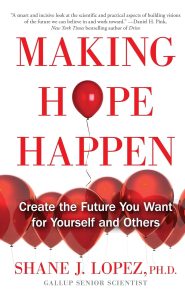
Making Hope Happen
Shane J. Lopez
In Making Hope Happen, Shane J. Lopez reveals that hope is not wishful thinking but a learnable, actionable process built on clear goals, adaptable pathways, and the belief that our efforts matter. His research and stories show how hope fuels resilience, purpose, and connection —especially vital in the third period of life, when adapting to change and envisioning new possibilities sustains wellbeing. Lopez reminds us that hope is both personal and shared: a renewable resource we can cultivate within ourselves and spark in others.

8 Ways to Hope: Charting a Path Through Uncertain Times
William R. Miller
In 8 Ways to Hope: Charting a Path Through Uncertain Times, psychologist William R. Miller explores the many forms hope can take: desire, trust, perseverance, meaning, and community, among them. Drawing from science, history, and story, he reveals that hope is not one emotion but a family of strengths that help us endure uncertainty, find purpose, and act with courage. For those in the third period of life, Miller’s framework offers both comfort and challenge: to adapt with grace, to persevere when paths narrow, and to remember that hope, at its core, is a choice, one that can still be shared, renewed, and lived every day.